L-THEANINE (THE SWEET ONE)
Sweetness & savouriness
What makes good matcha taste smooth, sweet and savoury. Dissolves readily at moderate temperatures — and degrades under high heat.
HAPPY AT 70–80 °C · DAMAGED NEAR BOILING
The matcha machine · Pre-order the launch run
Every "matcha maker" on the market is a milk frother with a new label — one thin wire that whips bubbles instead of breaking up powder. Matcha Forge has a proper whisk head: 36 stiff tines that shear the matcha smooth in about 30 seconds. No clumps, no grit, no wrist technique, no bitterness.
Ships from the launch run · Cancel any time before dispatch · 60-day money-back
The part that actually matters
They look similar in a product photo and they do completely different jobs. The difference is entirely in the head — how many contact points it has, how close they run to the floor of the cup, and which way they travel.
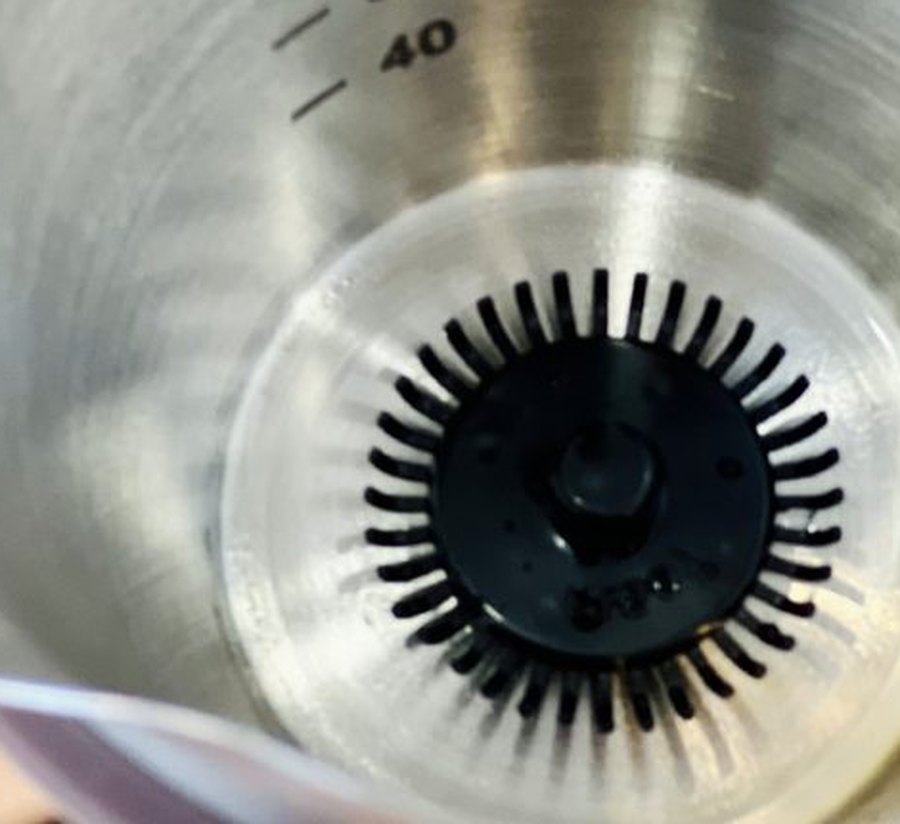
A chasen — the hand-cut bamboo whisk used in Japanese tea houses — works because it has eighty-odd fine tines passing through the powder at once, breaking clumps by sheer number of contact points. Our head carries 36 stiff tines in a ring. A frother spring has one continuous wire — which is why it whips air instead of shearing powder.
Matcha sinks. Clumps form and stay on the bottom of the vessel, which is exactly where a frother's spring never reaches. The tine ring runs millimetres off the cup floor, so it hits the powder where the powder actually is.
Spinning makes a vortex and a vortex folds in air. The drive reverses direction constantly in a W pattern — the same back-and-forth a trained hand makes — so the powder is cut and dispersed evenly through the water, rather than whipped into a head of foam.
Done right you get a crema — the fine, tight layer that sits on a proper matcha, the way it does on espresso. Not a mug of airy bubbles that collapses before you reach the table.
What comes out
This is the point of all of it. Whisked properly, matcha stops being a cloudy green drink and becomes a shot — thick, even, and heavy enough to fall through milk in ribbons instead of dispersing on contact.
Straight from the cup's pour spout.
No sieve, no second vessel, no spoon.
Ships from the launch run · Cancel any time before dispatch
The other half of the problem
A perfect whisk into water that's too hot still tastes harsh. Above roughly 80 °C the bitter catechins flood out and the sweetness burns off — and because matcha is a suspension you drink the whole powder, so there's no undoing it. The machine shows you the moment the water is right.
What makes good matcha taste smooth, sweet and savoury. Dissolves readily at moderate temperatures — and degrades under high heat.
Healthy, but harsh in excess. Extraction accelerates sharply above ~80 °C — boiling water floods the cup and the bitterness buries everything else.
Matcha isn't brewed like tea — the powder never leaves the cup, so it has to be broken up and held evenly in the water. That's what proper whisking does. Stirring leaves it gritty and settling.
Two ways to own it
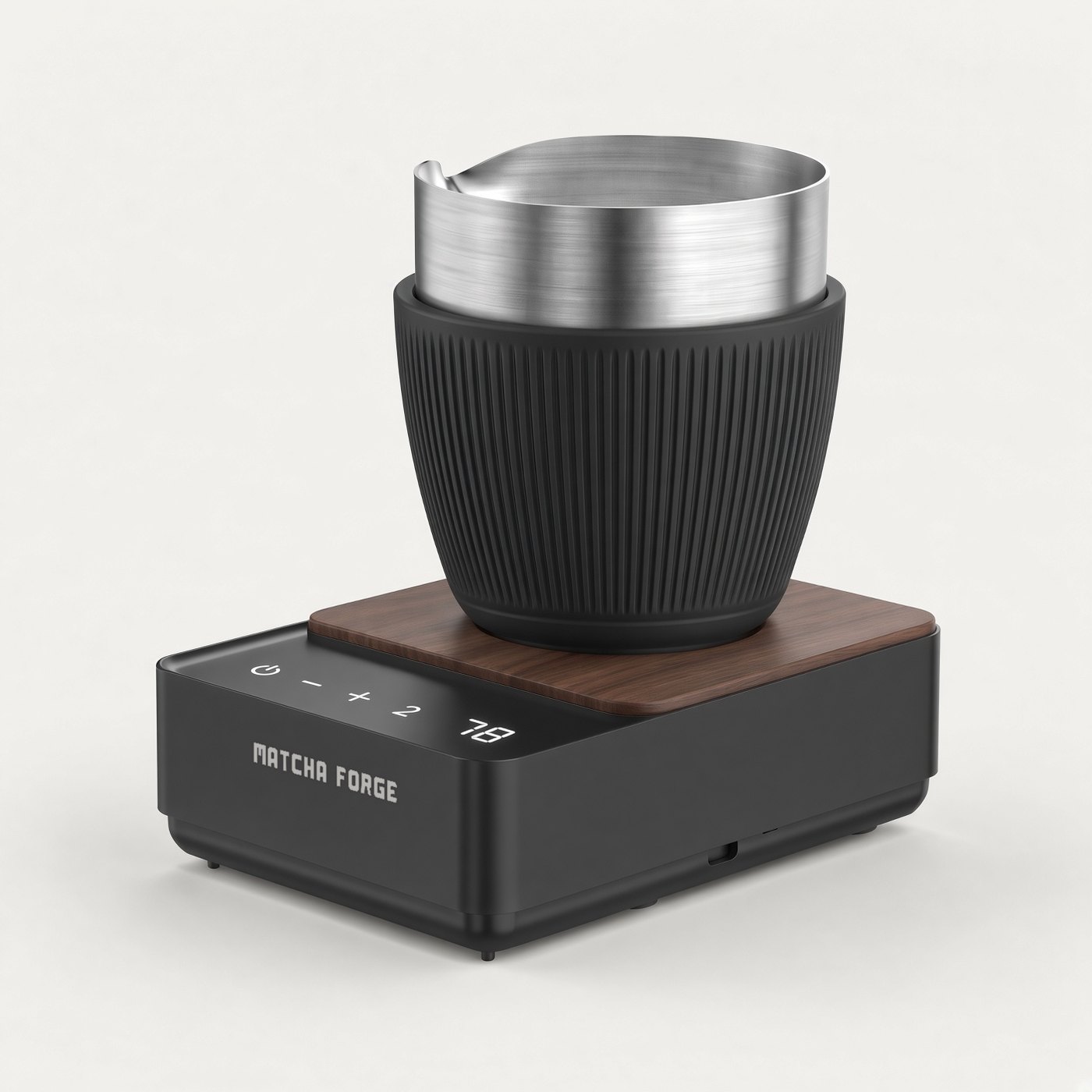
Same whisk head, same drive, same 40–120 ml stainless cup. The difference is the deck it stands on and the grip in your hand.
Founders Edition · Limited run
A panel of dark American walnut, inlaid flush into the deck the cup stands on, under a flush pane of glass. Charcoal fluted sleeve. Numbered, and made once.
FROM €149
JOIN THE FOUNDERS LISTRegistration of interest — no payment taken. Walnut tooling is being finalised; list members are offered their number first, at the price above, before anyone else.
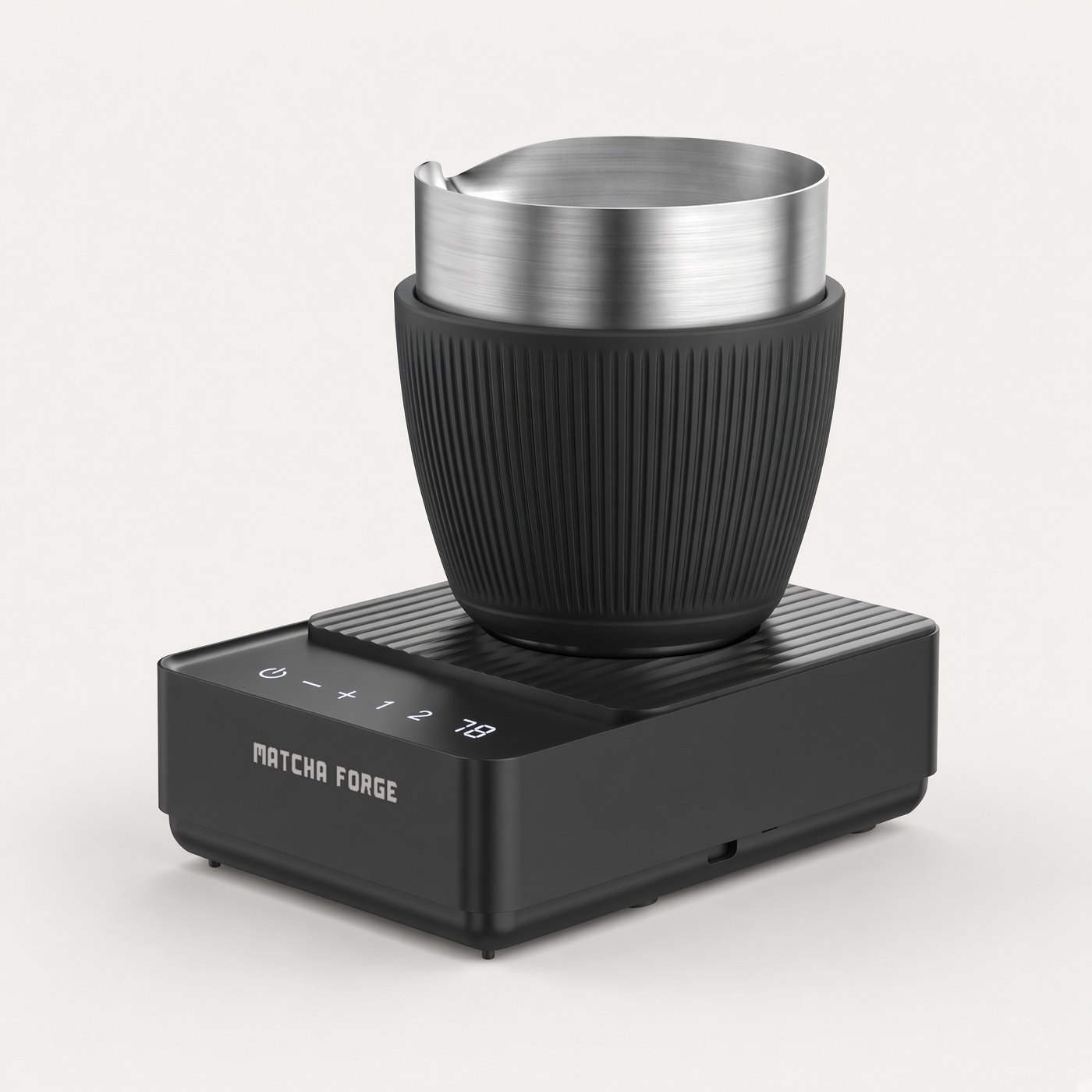
The Forge · Standard
The same machine in a matte black deck, with the fluted silicone sleeve in your choice of three. Because your counter isn't everyone's counter.
FROM €99
PRE-ORDER THE LAUNCH RUNPre-order holds your place in the first shipment. Cancel any time before dispatch for a full refund.
Why trust it before anyone's reviewed it
Count them in the photo above: 36 tines, seated millimetres off the cup floor. That's not marketing language — it's the part, photographed. Every claim on this page is about geometry you can see.
Make matcha with it every morning for two months. If it isn't better than what you were doing before, send it back for everything you paid. The risk sits with us, which is where it belongs before anyone's reviewed it.
The launch run is the first hundred machines and we're not pretending otherwise. Buyers get a €20 credit for an honest review — good or bad, unedited, published as written. That's how the reviews on this page will get here.
No reviews yet, no press logos, no borrowed credibility. When there are real ones, they'll be here.
Ninety seconds
Any kettle you already own. No smart hardware needed for the water.
Pour into the pot and watch the strip cool into green.
Two grams sifted, water on top, seat the cup, press a preset.
Straight from the spout. Drink it as it is, or pour it into milk that finally deserves it.
No, and the head is where you can see it. A frother uses one thin wire spring designed to whip air into milk. Matcha Forge uses a dense ring of 36 short stiff tines running millimetres off the cup floor, driven in a constantly reversing W pattern. One folds in air and makes bubbles; the other shears powder and makes a suspension. That's why a frother gives you matcha-flavoured foam and this gives you a shot with crema.
No. The head is built on the chasen's principle — many fine tines moving through the powder at once — and the W-motion drive reproduces the shear a trained wrist makes. You get the chasen's result without the chasen's technique, and without soaking, drying and eventually replacing a bamboo whisk that cracks. If you love the ritual, keep it; they coexist happily. The machine just makes the result repeatable on a Tuesday morning.
Almost always the water was too hot. Above ~80 °C, catechins — matcha's bitter, astringent compounds — extract aggressively while the delicate L-theanine that carries sweetness degrades. Because you drink the whole powder, over-extraction can't be undone. Pour at 75–80 °C and the same tin of matcha tastes sweet and rounded instead of harsh.
70–80 °C, with 75–80 °C the sweet spot for usucha. That's where amino acids dissolve well and bitterness stays controlled — and exactly where the pot's green band sits.
40–120 ml food-grade stainless cup with a pour spout. Three presets, eighteen adjustable speeds, five to 120 seconds. USB-C charging, waterproof body, 151 × 153 mm on the counter. Ceremonial or culinary grade both work — there's a preset for each.
No — and that's deliberate. Heating elements are what make these machines expensive, heavy and prone to failure, and you already own a kettle. Matcha Forge does the part a kettle can't: the whisking. You boil, let it drop to 75–80 °C, and pour. If you want that step made foolproof, the Zone pot shows you the window with a colour strip.
Rinse the cup under the tap — matcha doesn't bake on the way milk does. The whisk head lifts out for a proper wash. The body is sealed and waterproof, so a wipe is all it needs. No milk residue means no soaking, which is the main reason frother jugs get abandoned in a cupboard.
It's a small motor in a stainless cup for under a minute — quieter than a milk frother and far quieter than a blender. It charges over USB-C and runs a couple of weeks of daily use per charge, so it lives on the counter without a cable.
Send it back within 60 days for a full refund, used or not. We'd rather you tried it properly than kept a box sealed "just in case". Return shipping on us if the machine is faulty.
Free shipping across the EU and UK on every pre-order. Duties are prepaid — the price you see is the price you pay, with nothing owed at the door.
The launch run ships from the date shown at checkout. Pre-order holders are first in the queue. If that date moves by more than two weeks we'll email you and you can cancel for a full refund, no questions asked — and you can cancel any time before dispatch regardless.
Launch run
Drop your email and we'll send the pre-order link the moment the run opens — with the launch code, before the public price applies. Founders numbers are offered to this list first.